Last night we went out with Kim, Yukie and El Zori for caracoles at a bar near the cathedral. We left just about sunset and it was a long walk cause Zori kept pausing as he talked to us. They were the best caracoles I've had, sure enough. We all ordered seconds.
Zori invited us to the Peña Buleria today and the girls couldn't go because of a previous date, but Geoffrey and I went. We got there ahead of him, though we went later than he told us. It's a little intimidating at first, cause it is open to everyone but not totally. It's hard to understand - it's a club, and the people going for lunch pay a monthly fee to belong. If we were to go all the time, we should really pay, though they are so welcoming, they tell us, "This is your house, come whenever you want". Yet at the door, they stop and ask you, "Yes, can we help you?" If you say someone has invited you then no problem. Anyways, Antonio, a gentleman who can be seen selling lottery tickets on the street, hanging out at the Tres Reyes (bar where the fishmongers and Geoffrey go), and singing Saetas during Semana Santa, comes and puts a big plate of sardines in front of us, and tells the bartender to give us some tapas of tortilla on bread, they give us tomato and tuna salad, and keep bringing more and more sardines. There are very few people today; just three tables of people, only one woman among them all. Zori arrives and doesn't recognize us, cause Geoffrey's wearing a white and magenta striped shirt, and looks like "one of us", whereas last night he had a Giri (foreigner) shirt.
I get some stories from both Antonio and Zori about their childhood growing up in the neighbourhood. These men were born here, beside other famous flamenco singers, Zori being the cousin of Paquera, and Antonio living on the same street as, and playing with various flamenco heavyweights. He said up to about 7 years old they would play stuff like marbles and whatever, in the street, but about that age, they started to rap their knuckles on the table and sing. Just hanging out in their spare time doing that, I suppose.
After someone comes by with ice cream sandwiches and we have a few more drinks and Geoffrey has even more sardines, Gasolina starts to sing. Three other guys take turns doing solea por bulerias, then Antonio starts up with some bulerias and I can hardly stay in my chair. That's what it's supposed to be like. When someone sings bulerias for real, their is so much rhythm (there is not a proper English word to describe what there is - it's called soniquete - groove would be the closest thing), well, there is so much groove, you almost automatically dance. I only need a little bit more time and to feel slightly more at home there, and I'll do it. I am almost there.
Zori is 78 and has just lost his wife. He has always loved flamenco more than any other pursuit, like work and all the duties of raising a family. Finally he can just dedicate himself to it completely. He stays out later than people our age, and is constantly partying. His nephew Jose Mendez has a lot of gigs, in Seville and abroad. Zori often joins him, and is invited up to dance bulerias for the final number, whenever he goes along. He is renowned in Jerez and somewhat in Sevilla for his "arte" (art + something else not involved in the English word art... perhaps whimsy, sense of fun, "cool", and joie de vivre all combined). His daughter calls him and tries to invite him for breakfast, for dinner, to make sure he's not alone, but he's always out with friends and admirers.
He told us his name comes from going to school on the San Telmo hill and during recess, the kids would run to catch up with the Zorrillos (sp?), a type of cart that came from Sanlucar, carrying packages. He would always be the first one to catch up to the cart and so was named Zorillo, later it got shortened.
The singing was like heaven. Not because it is a stereotypically whitewashed "heaven-y" kind of sound, but because it seems to come from deep down, with no barriers to self expression, and equally important, it comes from a certain context and is done in a certain context which infuses the singing. One where people hang out without a schedule, where time is not important, there is spaciousness - a lack of anxiety or pressure that is present in most other settings in my life but is so normal and is anyways only an undetectable undercurrent but colours everything, but is only noticeable when it's missing. They have inherited a living tradition with huge meaning and significance, and a high form of art has been of central importance in their everyday lives, all their lives, and they have shared this together for years. You feel or know all of this as you are sitting there listening to them, you hear it in their singing.
Saturday, June 15, 2013

Sunday, May 19, 2013
I just got back from Sevilla. How happy I am to be in Jerez. There's a fresh breeze from the ocean, it's totally quiet on a Sunday afternoon at 4 pm.
We are going to have shark steaks on the barbeque for dinner. There are storks circling above the rooftop. Geoffrey is up there doing stuff in his workshop; just finished making himself a table saw out of a metal bed frame and various odd bits of metal, and a regular power saw which he set underneath it.
I am sanding my shoe lasts.
I was with Sachiko and some other friends last night at a peña where Pepe Torres danced. We went out afterwards to the main place for flamenco. Hidden in a place with the door half down, it lasts all night as long as the police don't come and force it to close down. There is no good place where they can sing and do what they want, as somebody is always bothered. It used to be the norm in Sevilla in certain neighbourhoods. Unfortunately and amazingly, the city allows music to be blasting from numerous huge speakers at an all night concert, keeping up everyone in that entire section of the city till 6 am, but a few people playing quality music, un-amplified, are shut down. Anyways, thank goodness Jerez is different. It is a community event complete with older people, here, and there is usually not a problem when it goes all night because, at least I suppose, people know that this is normal life here so they shouldn't live beside a peña if they don't want to hear it.
It makes me realise all the more how unique this place is where I live, what a treasure it is. A cultural treasure, a way of life that hardly exists anywhere else.
We are going to have shark steaks on the barbeque for dinner. There are storks circling above the rooftop. Geoffrey is up there doing stuff in his workshop; just finished making himself a table saw out of a metal bed frame and various odd bits of metal, and a regular power saw which he set underneath it.
I am sanding my shoe lasts.
I was with Sachiko and some other friends last night at a peña where Pepe Torres danced. We went out afterwards to the main place for flamenco. Hidden in a place with the door half down, it lasts all night as long as the police don't come and force it to close down. There is no good place where they can sing and do what they want, as somebody is always bothered. It used to be the norm in Sevilla in certain neighbourhoods. Unfortunately and amazingly, the city allows music to be blasting from numerous huge speakers at an all night concert, keeping up everyone in that entire section of the city till 6 am, but a few people playing quality music, un-amplified, are shut down. Anyways, thank goodness Jerez is different. It is a community event complete with older people, here, and there is usually not a problem when it goes all night because, at least I suppose, people know that this is normal life here so they shouldn't live beside a peña if they don't want to hear it.
It makes me realise all the more how unique this place is where I live, what a treasure it is. A cultural treasure, a way of life that hardly exists anywhere else.
Friday, May 17, 2013
Today a student told me that she doesn't like Cadiz very much, due to negative experiences there. I forget the exact nature of them, but they were involving business. She works for large companies directing things.
I already know that the Gaditanos (people of Cadiz) are happy-go-lucky people. I have always automatically felt happy being there. Besides it is beautiful. It is on the Costa de la Luz (coast of light) and the first time I went there, the light had a heavenly quality to it. I'm sure I've said before that it is the only place in Spain where the traditional carnival survived the dictatorship, so they told me. They are utterly hilarious and take their ridiculousness and irreverence quite seriously. Besides, their humour is a good percentage of the time, quite intelligent, and they are known for having a mildly anarchist bent.
Well, said my student, the director of the company showed up to a meeting with the bank to ask for money, wearing shorts. They don't take anything seriously, she said. I think the company may not have survived.
The only major and important form of flamenco song in a major key is Alegrias (happiness), which is an invention of Cadiz. I have not studied it much, but just did so last month. I am currently trying to learn a few letras (verses) and to sing it a bit, so that I can understand the dance better. Generally I don't really enjoy listening to this form, as is just lacks guts, many times. But that depends who you listen to. Here is La Perla de Cadiz (the Pearl of Cadiz) singing one. I believe she is dead now, but don't quote me. She is accompanied by Paco Cepero, a flamenco giant, who lives here, and whom we shared the bar with a few Saturdays ago at the Tabanco (place where sherry is served out of barrels piled up).
La Perla de Cadiz
I already know that the Gaditanos (people of Cadiz) are happy-go-lucky people. I have always automatically felt happy being there. Besides it is beautiful. It is on the Costa de la Luz (coast of light) and the first time I went there, the light had a heavenly quality to it. I'm sure I've said before that it is the only place in Spain where the traditional carnival survived the dictatorship, so they told me. They are utterly hilarious and take their ridiculousness and irreverence quite seriously. Besides, their humour is a good percentage of the time, quite intelligent, and they are known for having a mildly anarchist bent.
Well, said my student, the director of the company showed up to a meeting with the bank to ask for money, wearing shorts. They don't take anything seriously, she said. I think the company may not have survived.
The only major and important form of flamenco song in a major key is Alegrias (happiness), which is an invention of Cadiz. I have not studied it much, but just did so last month. I am currently trying to learn a few letras (verses) and to sing it a bit, so that I can understand the dance better. Generally I don't really enjoy listening to this form, as is just lacks guts, many times. But that depends who you listen to. Here is La Perla de Cadiz (the Pearl of Cadiz) singing one. I believe she is dead now, but don't quote me. She is accompanied by Paco Cepero, a flamenco giant, who lives here, and whom we shared the bar with a few Saturdays ago at the Tabanco (place where sherry is served out of barrels piled up).
La Perla de Cadiz
Saturday, April 13, 2013
Why I am here:
This month there are shows again at Peña Buleria. There weren't advertised anywhere except a poster on the door and maybe in a couple of strategic places in the city. They are free and they are mostly attended by locals who belong to a large kind of thing that seems like a family. It is a true community. They seem closed because they all know each other and they share this common, incredible thing. They are not closed though, and welcome outsiders but don't really seem to be bothered by us for the most part. I suppose that is because their own "thing" is so strong, alive and well. We are kind of neither here nor there. At least this is my current understanding of it. That is exactly how it should be, I think.
Last night was Momito, one of the so called "Momo" clan, who have illustrious members. I know at least two of them to chat with or hang out with (not the really illustrious ones, but some who are good singers).
Again, I have the feeling at this peña, that I have entered into heaven already. The last is always bulerias, and two palmeros got behind the singer to "clap" and shout. The singer is already pouring out everything in him, but the palmeros are encouraging him on with explosive loud yells. Many people all over the "audience" yell as well, when the wave strikes them/when the spirit moves them. The energy involved in flamenco is like that of old fashioned acoustic blues... there is nothing hyper. It is grounded and has a solid feeling, but heat like a fire.
Totally foreign to the rest of us... I have no idea how to explain. Last night I thought I have never seen so much true joy as what I see in flamenco. It is harsh, raw and completely real and spills everything out. But when they get to bulerias, then that's what it is. The ultimate meaning of party. Which is what heaven should be, I assume. Singing and dancing, clapping and shouting.
After the show is over, we hang out for a while and tonight they just happened to spontaneously erupt into singing for a while. A large circle opens up and someone steps in and starts singing. People accompany by clapping. Someone else sings. Somebody feels like dancing and steps into the middle. Old men with white hair in suits and young ones with funky jeans almost falling off. All are equally involved. Un-scripted goofing around but within a sophisticated musical framework, which involves being totally in tune with another person who's singing or dancing.
Something vital is here that I am missing. I get a transfusion when I go stand even just watching, that allows me to carry on.
This month there are shows again at Peña Buleria. There weren't advertised anywhere except a poster on the door and maybe in a couple of strategic places in the city. They are free and they are mostly attended by locals who belong to a large kind of thing that seems like a family. It is a true community. They seem closed because they all know each other and they share this common, incredible thing. They are not closed though, and welcome outsiders but don't really seem to be bothered by us for the most part. I suppose that is because their own "thing" is so strong, alive and well. We are kind of neither here nor there. At least this is my current understanding of it. That is exactly how it should be, I think.
Last night was Momito, one of the so called "Momo" clan, who have illustrious members. I know at least two of them to chat with or hang out with (not the really illustrious ones, but some who are good singers).
Again, I have the feeling at this peña, that I have entered into heaven already. The last is always bulerias, and two palmeros got behind the singer to "clap" and shout. The singer is already pouring out everything in him, but the palmeros are encouraging him on with explosive loud yells. Many people all over the "audience" yell as well, when the wave strikes them/when the spirit moves them. The energy involved in flamenco is like that of old fashioned acoustic blues... there is nothing hyper. It is grounded and has a solid feeling, but heat like a fire.
Totally foreign to the rest of us... I have no idea how to explain. Last night I thought I have never seen so much true joy as what I see in flamenco. It is harsh, raw and completely real and spills everything out. But when they get to bulerias, then that's what it is. The ultimate meaning of party. Which is what heaven should be, I assume. Singing and dancing, clapping and shouting.
After the show is over, we hang out for a while and tonight they just happened to spontaneously erupt into singing for a while. A large circle opens up and someone steps in and starts singing. People accompany by clapping. Someone else sings. Somebody feels like dancing and steps into the middle. Old men with white hair in suits and young ones with funky jeans almost falling off. All are equally involved. Un-scripted goofing around but within a sophisticated musical framework, which involves being totally in tune with another person who's singing or dancing.
Something vital is here that I am missing. I get a transfusion when I go stand even just watching, that allows me to carry on.
Suddenly I am back to Sevilla... two days a week. Nothing can drag me there normally. But I am going for Pepe Torres. He is substituting for Farruquito (most famous dancer in existence currently) for 2 months.
Pepe has a tiny fraction of the fame that Farruquito does, but has a heritage just as impressive. He is grand-nephew of the most fantastic guitarist ever (flamenco guitarist, anyways). He looks like his great uncle and has an attitude a little bit like that, at least from a distant observer's point of view. Diego del Gastor's greatness was unsurpassed. He accompanied some of the best singers that ever were and maybe ever will be, but there was something strange about the way he regarded money and performing. I don't remember clearly but I think he was not a professional, per se. He did not attempt to sell himself. He was from a small mountain town. Pepe is from Moron, a small town, and he also lacks ego. Sometimes the best artists don't receive as much fame as others to whom they are at least equal.
I saw Pepe dance during the festival (once before too, in 2011), and have been obsessed by his marking for a month. Marking are plain, slower steps, more like dancing or even posing, different from continual percussion that happens between. Marking happens during the main part of the singing, to accompany the "verses" that the singer sings. In between is the fireworks (lots of percussive feet), which can often be overdone and which cause many performers these days to lack soul or depth, when they concentrate overly on them.
I loved the whole show but I was obsessed by two "measures" (compass) of very plain, minimalistic steps he did, that were mainly just a suggestion of the typical steps always done. He did that with such presence, and the subtlety of the steps was so perfect. When I ran into some fellow dancers on the corner one morning and went for a beer with them, I had already been toying with the idea of going to Sevilla for his classes, but this convinced me completely.
I missed the first two classes and what he teaches is beyond my level in difficulty - very advanced. But I went along and took the class anyways. I am proud of myself that I've got to the point that I can look at two measures of moves and say "that is what I want" and take a class for that reason. Now I just have to fight with my ego not to worry when I don't pick up all the incredibly complicated footwork, which besides that, is all off the beat, and try to concentrate on what I want to get out of it. The first thing we did, I was laughing and shaking my head in disbelief. Anyways, Pepe is a wonderfully down to earth, kind person and tries to make sure the slow girls in the class get stuff too.
I will need my friends' help to figure this stuff out.
Here is Pepe
http://www.youtube.com/watch?v=ZvOXPNJnw-s
http://www.youtube.com/watch?v=h89yA91Flw4
Pepe has a tiny fraction of the fame that Farruquito does, but has a heritage just as impressive. He is grand-nephew of the most fantastic guitarist ever (flamenco guitarist, anyways). He looks like his great uncle and has an attitude a little bit like that, at least from a distant observer's point of view. Diego del Gastor's greatness was unsurpassed. He accompanied some of the best singers that ever were and maybe ever will be, but there was something strange about the way he regarded money and performing. I don't remember clearly but I think he was not a professional, per se. He did not attempt to sell himself. He was from a small mountain town. Pepe is from Moron, a small town, and he also lacks ego. Sometimes the best artists don't receive as much fame as others to whom they are at least equal.
I saw Pepe dance during the festival (once before too, in 2011), and have been obsessed by his marking for a month. Marking are plain, slower steps, more like dancing or even posing, different from continual percussion that happens between. Marking happens during the main part of the singing, to accompany the "verses" that the singer sings. In between is the fireworks (lots of percussive feet), which can often be overdone and which cause many performers these days to lack soul or depth, when they concentrate overly on them.
I loved the whole show but I was obsessed by two "measures" (compass) of very plain, minimalistic steps he did, that were mainly just a suggestion of the typical steps always done. He did that with such presence, and the subtlety of the steps was so perfect. When I ran into some fellow dancers on the corner one morning and went for a beer with them, I had already been toying with the idea of going to Sevilla for his classes, but this convinced me completely.
I missed the first two classes and what he teaches is beyond my level in difficulty - very advanced. But I went along and took the class anyways. I am proud of myself that I've got to the point that I can look at two measures of moves and say "that is what I want" and take a class for that reason. Now I just have to fight with my ego not to worry when I don't pick up all the incredibly complicated footwork, which besides that, is all off the beat, and try to concentrate on what I want to get out of it. The first thing we did, I was laughing and shaking my head in disbelief. Anyways, Pepe is a wonderfully down to earth, kind person and tries to make sure the slow girls in the class get stuff too.
I will need my friends' help to figure this stuff out.
Here is Pepe
http://www.youtube.com/watch?v=ZvOXPNJnw-s
http://www.youtube.com/watch?v=h89yA91Flw4
Saturday, April 6, 2013
Saturday afternoon normally involves going to an alley across from the market. On one side of the alley there is a Tabanco (place which traditionally sells sherry from barrels, and which currently also hosts local flamenco singers with a microphone Saturday afternoons) and across from it is a tiny bar with tables for standing only, just outside. It is here we usually end up, because of our friends, Juan, Gonzalo, Marco, and various others who come and go. Not many other foreign flamenco dancers go there, but occassionally one who has been here a long time drops by.
I generally feel like staying home these days, sitting in the sun and working on my projects, when I don't have a specific event or work to go to. I often feel too intimidated by the rest of the flamenco community here. But with these guys I feel comfortable, and especially with Juan. Juan doesn't even go on about my blue eyes or that I'm guapa, which practically all of the old men do, and even though many of them are lovely and trustworthy people, it's just so much nicer to be treated as a human. Juan must be close to my parents' age. I've never seen him without his narrow rimmed fedora. He has a gold tooth or two and the rest look like they are only hanging there. He loves to sing - he can't stop himself though he is supposed to be taking a rest. Last time he expressed some strong views on life here and mentioned some history which was very interesting to me. Today he explained about his visit to a throat specialist and what exactly the vocal chords do and how they look. He has to learn to sing with his diaphragm so he can continue to sing at all. Jose, a recent acquaintance in this gang, told us about Juan hanging out at a camp (with tents) near plaza Arenal last year. Everyone who was in the city at that time saw this camp, which was in protest of the awful economic situation, specifically of the corrupt city hall. The campers were trying to uphold a serious image for the media, and although Juan was there to support them (and from the sounds of it, he believes just as deeply in the cause as anyone, and perhaps more), he always brought a bottle of wine and wanted to sing, which according to the serious Jose, was disasterous.
This is exactly why I like Juan.
I generally feel like staying home these days, sitting in the sun and working on my projects, when I don't have a specific event or work to go to. I often feel too intimidated by the rest of the flamenco community here. But with these guys I feel comfortable, and especially with Juan. Juan doesn't even go on about my blue eyes or that I'm guapa, which practically all of the old men do, and even though many of them are lovely and trustworthy people, it's just so much nicer to be treated as a human. Juan must be close to my parents' age. I've never seen him without his narrow rimmed fedora. He has a gold tooth or two and the rest look like they are only hanging there. He loves to sing - he can't stop himself though he is supposed to be taking a rest. Last time he expressed some strong views on life here and mentioned some history which was very interesting to me. Today he explained about his visit to a throat specialist and what exactly the vocal chords do and how they look. He has to learn to sing with his diaphragm so he can continue to sing at all. Jose, a recent acquaintance in this gang, told us about Juan hanging out at a camp (with tents) near plaza Arenal last year. Everyone who was in the city at that time saw this camp, which was in protest of the awful economic situation, specifically of the corrupt city hall. The campers were trying to uphold a serious image for the media, and although Juan was there to support them (and from the sounds of it, he believes just as deeply in the cause as anyone, and perhaps more), he always brought a bottle of wine and wanted to sing, which according to the serious Jose, was disasterous.
This is exactly why I like Juan.
Tuesday, April 2, 2013
Semana Santa in Jerez
Viernes Santo (good Friday), this was from our balcony, just at the corner of the street. Started at the Ermita San Telmo I think it's called, just 2 blocks away, where when the Jesus (wearing real human hair, nice long, black locks) was sung to, just after he made his appearance. Someone standing on the rooftop just beside the church, started to sing. It was quite impressive, seeing his sillhouette against a grey sky. A little later they passed by our corner here. I made 15 minutes of video but can't upload it.


This is Thursday night, "madrugada" means dawn, I think (which means you stay up until dawn if you celebrate it properly). We were on our friends' balcony while this crowd gathered. The height of the crowd was around 2 am, just when the procession was reaching the square. Suddenly it started to rain and the whole procession stopped and headed back to the church. The evening was ruined for many. A year of anticipation, for some people for whom this is their entire life.

 Crowds waiting in the square outside bar Maypa, normally an unassuming place, which comes to life during Semana Santa, including a bar next door which only opens one week a year - for this holiday. I believe they are waiting here to here Saetas which are normally sung outside the bar. I saw a large collection of important neighbourhood flamenco people when I arrived at our friends' house. The paso (float) is also borne by a group who traditionally makes it dance, right here in the square. Their normally slow, shuffling steps that resemble a chain gang walk (they are officially doing penitence, carrying the floats), turn into a semi-dance, at least as much as a bunch of guys carrying a few tons can possibly dance. It is very cool, because of the contrast with the normal paso-carrying walk. I have only seen something similar on video in Sevilla.
 An Irish acquaintance with a Spanish wife, friends of our friends with the balcony, said his son wanted to be a penitent one year. It was the cool thing to do. He was only seven years old, but his friends were doing it.
This is a few nights earlier. Monday night's pasos.


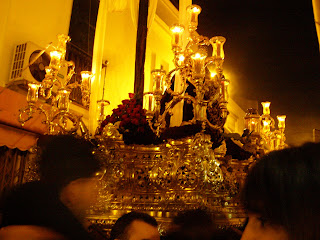
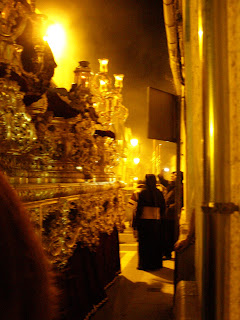

Thank goodness the streets can get back to normal now. The center of the city, where I have to ride every day, was crowded with red booths, where chairs would be set each day between about 6-9 pm, for people to sit and watch each paso go by, after coming out of their respective churches and before going back to them later. They started putting out the red booths sometime early in March. They took up a large part of the street and sidewalk in some areas, and one street was entirely blocked off to traffic for the week.
Viernes Santo (good Friday), this was from our balcony, just at the corner of the street. Started at the Ermita San Telmo I think it's called, just 2 blocks away, where when the Jesus (wearing real human hair, nice long, black locks) was sung to, just after he made his appearance. Someone standing on the rooftop just beside the church, started to sing. It was quite impressive, seeing his sillhouette against a grey sky. A little later they passed by our corner here. I made 15 minutes of video but can't upload it.


This is a few nights earlier. Monday night's pasos.


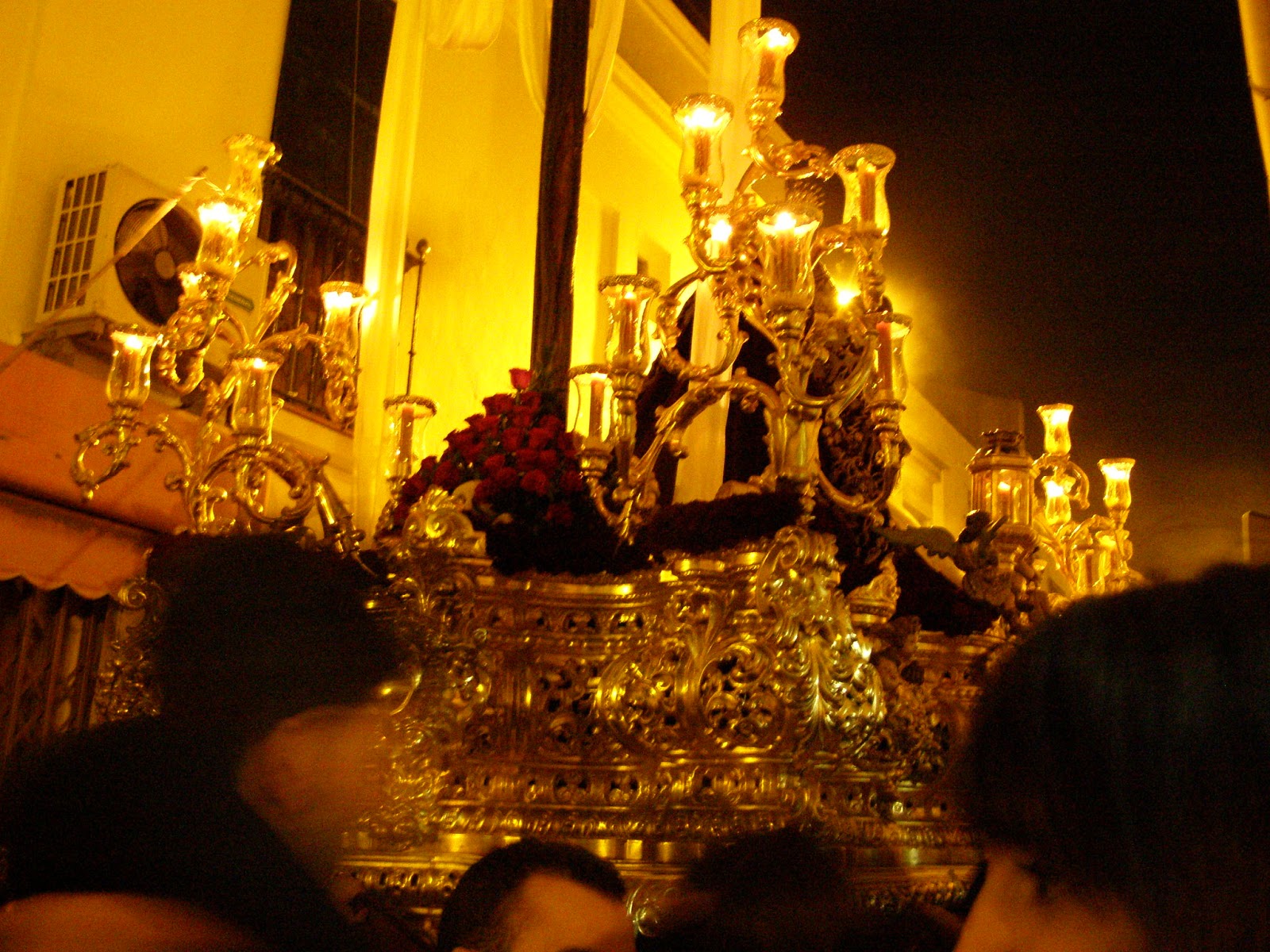


Thank goodness the streets can get back to normal now. The center of the city, where I have to ride every day, was crowded with red booths, where chairs would be set each day between about 6-9 pm, for people to sit and watch each paso go by, after coming out of their respective churches and before going back to them later. They started putting out the red booths sometime early in March. They took up a large part of the street and sidewalk in some areas, and one street was entirely blocked off to traffic for the week.
Subscribe to:
Posts (Atom)