Suddenly I am back to Sevilla... two days a week. Nothing can drag me there normally. But I am going for Pepe Torres. He is substituting for Farruquito (most famous dancer in existence currently) for 2 months.
Pepe has a tiny fraction of the fame that Farruquito does, but has a heritage just as impressive. He is grand-nephew of the most fantastic guitarist ever (flamenco guitarist, anyways). He looks like his great uncle and has an attitude a little bit like that, at least from a distant observer's point of view. Diego del Gastor's greatness was unsurpassed. He accompanied some of the best singers that ever were and maybe ever will be, but there was something strange about the way he regarded money and performing. I don't remember clearly but I think he was not a professional, per se. He did not attempt to sell himself. He was from a small mountain town. Pepe is from Moron, a small town, and he also lacks ego. Sometimes the best artists don't receive as much fame as others to whom they are at least equal.
I saw Pepe dance during the festival (once before too, in 2011), and have been obsessed by his marking for a month. Marking are plain, slower steps, more like dancing or even posing, different from continual percussion that happens between. Marking happens during the main part of the singing, to accompany the "verses" that the singer sings. In between is the fireworks (lots of percussive feet), which can often be overdone and which cause many performers these days to lack soul or depth, when they concentrate overly on them.
I loved the whole show but I was obsessed by two "measures" (compass) of very plain, minimalistic steps he did, that were mainly just a suggestion of the typical steps always done. He did that with such presence, and the subtlety of the steps was so perfect. When I ran into some fellow dancers on the corner one morning and went for a beer with them, I had already been toying with the idea of going to Sevilla for his classes, but this convinced me completely.
I missed the first two classes and what he teaches is beyond my level in difficulty - very advanced. But I went along and took the class anyways. I am proud of myself that I've got to the point that I can look at two measures of moves and say "that is what I want" and take a class for that reason. Now I just have to fight with my ego not to worry when I don't pick up all the incredibly complicated footwork, which besides that, is all off the beat, and try to concentrate on what I want to get out of it. The first thing we did, I was laughing and shaking my head in disbelief. Anyways, Pepe is a wonderfully down to earth, kind person and tries to make sure the slow girls in the class get stuff too.
I will need my friends' help to figure this stuff out.
Here is Pepe
http://www.youtube.com/watch?v=ZvOXPNJnw-s
http://www.youtube.com/watch?v=h89yA91Flw4
Saturday, April 13, 2013

Saturday, April 6, 2013
Saturday afternoon normally involves going to an alley across from the market. On one side of the alley there is a Tabanco (place which traditionally sells sherry from barrels, and which currently also hosts local flamenco singers with a microphone Saturday afternoons) and across from it is a tiny bar with tables for standing only, just outside. It is here we usually end up, because of our friends, Juan, Gonzalo, Marco, and various others who come and go. Not many other foreign flamenco dancers go there, but occassionally one who has been here a long time drops by.
I generally feel like staying home these days, sitting in the sun and working on my projects, when I don't have a specific event or work to go to. I often feel too intimidated by the rest of the flamenco community here. But with these guys I feel comfortable, and especially with Juan. Juan doesn't even go on about my blue eyes or that I'm guapa, which practically all of the old men do, and even though many of them are lovely and trustworthy people, it's just so much nicer to be treated as a human. Juan must be close to my parents' age. I've never seen him without his narrow rimmed fedora. He has a gold tooth or two and the rest look like they are only hanging there. He loves to sing - he can't stop himself though he is supposed to be taking a rest. Last time he expressed some strong views on life here and mentioned some history which was very interesting to me. Today he explained about his visit to a throat specialist and what exactly the vocal chords do and how they look. He has to learn to sing with his diaphragm so he can continue to sing at all. Jose, a recent acquaintance in this gang, told us about Juan hanging out at a camp (with tents) near plaza Arenal last year. Everyone who was in the city at that time saw this camp, which was in protest of the awful economic situation, specifically of the corrupt city hall. The campers were trying to uphold a serious image for the media, and although Juan was there to support them (and from the sounds of it, he believes just as deeply in the cause as anyone, and perhaps more), he always brought a bottle of wine and wanted to sing, which according to the serious Jose, was disasterous.
This is exactly why I like Juan.
I generally feel like staying home these days, sitting in the sun and working on my projects, when I don't have a specific event or work to go to. I often feel too intimidated by the rest of the flamenco community here. But with these guys I feel comfortable, and especially with Juan. Juan doesn't even go on about my blue eyes or that I'm guapa, which practically all of the old men do, and even though many of them are lovely and trustworthy people, it's just so much nicer to be treated as a human. Juan must be close to my parents' age. I've never seen him without his narrow rimmed fedora. He has a gold tooth or two and the rest look like they are only hanging there. He loves to sing - he can't stop himself though he is supposed to be taking a rest. Last time he expressed some strong views on life here and mentioned some history which was very interesting to me. Today he explained about his visit to a throat specialist and what exactly the vocal chords do and how they look. He has to learn to sing with his diaphragm so he can continue to sing at all. Jose, a recent acquaintance in this gang, told us about Juan hanging out at a camp (with tents) near plaza Arenal last year. Everyone who was in the city at that time saw this camp, which was in protest of the awful economic situation, specifically of the corrupt city hall. The campers were trying to uphold a serious image for the media, and although Juan was there to support them (and from the sounds of it, he believes just as deeply in the cause as anyone, and perhaps more), he always brought a bottle of wine and wanted to sing, which according to the serious Jose, was disasterous.
This is exactly why I like Juan.
Tuesday, April 2, 2013
Semana Santa in Jerez
Viernes Santo (good Friday), this was from our balcony, just at the corner of the street. Started at the Ermita San Telmo I think it's called, just 2 blocks away, where when the Jesus (wearing real human hair, nice long, black locks) was sung to, just after he made his appearance. Someone standing on the rooftop just beside the church, started to sing. It was quite impressive, seeing his sillhouette against a grey sky. A little later they passed by our corner here. I made 15 minutes of video but can't upload it.


This is Thursday night, "madrugada" means dawn, I think (which means you stay up until dawn if you celebrate it properly). We were on our friends' balcony while this crowd gathered. The height of the crowd was around 2 am, just when the procession was reaching the square. Suddenly it started to rain and the whole procession stopped and headed back to the church. The evening was ruined for many. A year of anticipation, for some people for whom this is their entire life.

 Crowds waiting in the square outside bar Maypa, normally an unassuming place, which comes to life during Semana Santa, including a bar next door which only opens one week a year - for this holiday. I believe they are waiting here to here Saetas which are normally sung outside the bar. I saw a large collection of important neighbourhood flamenco people when I arrived at our friends' house. The paso (float) is also borne by a group who traditionally makes it dance, right here in the square. Their normally slow, shuffling steps that resemble a chain gang walk (they are officially doing penitence, carrying the floats), turn into a semi-dance, at least as much as a bunch of guys carrying a few tons can possibly dance. It is very cool, because of the contrast with the normal paso-carrying walk. I have only seen something similar on video in Sevilla.
 An Irish acquaintance with a Spanish wife, friends of our friends with the balcony, said his son wanted to be a penitent one year. It was the cool thing to do. He was only seven years old, but his friends were doing it.
This is a few nights earlier. Monday night's pasos.


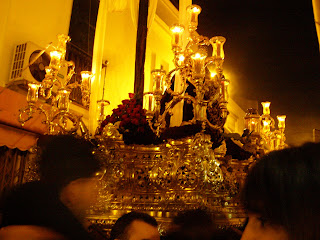
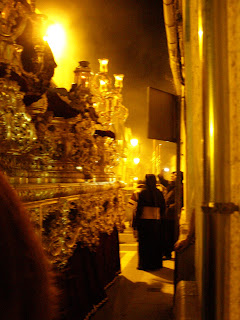

Thank goodness the streets can get back to normal now. The center of the city, where I have to ride every day, was crowded with red booths, where chairs would be set each day between about 6-9 pm, for people to sit and watch each paso go by, after coming out of their respective churches and before going back to them later. They started putting out the red booths sometime early in March. They took up a large part of the street and sidewalk in some areas, and one street was entirely blocked off to traffic for the week.
Viernes Santo (good Friday), this was from our balcony, just at the corner of the street. Started at the Ermita San Telmo I think it's called, just 2 blocks away, where when the Jesus (wearing real human hair, nice long, black locks) was sung to, just after he made his appearance. Someone standing on the rooftop just beside the church, started to sing. It was quite impressive, seeing his sillhouette against a grey sky. A little later they passed by our corner here. I made 15 minutes of video but can't upload it.


This is a few nights earlier. Monday night's pasos.


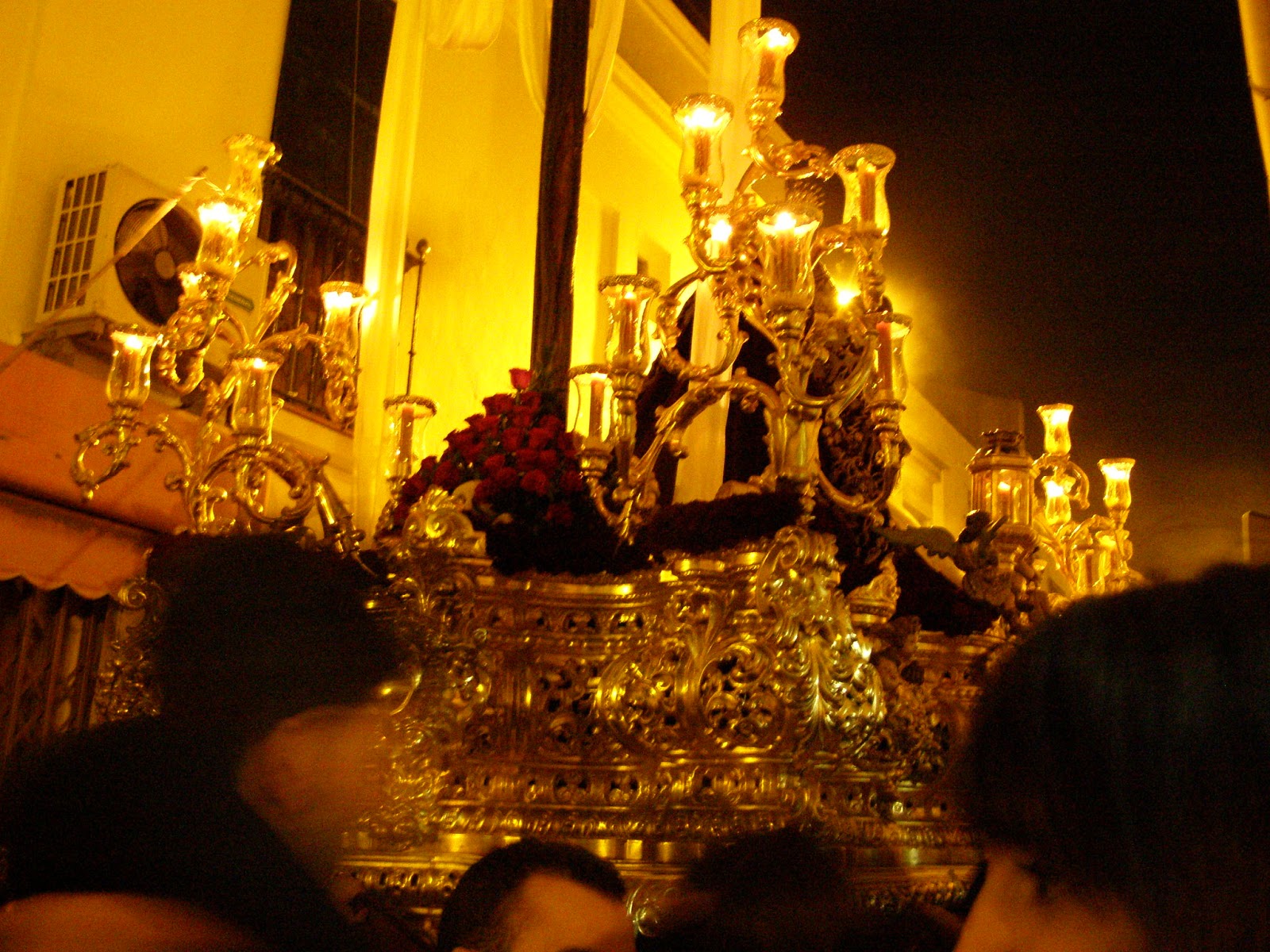


Thank goodness the streets can get back to normal now. The center of the city, where I have to ride every day, was crowded with red booths, where chairs would be set each day between about 6-9 pm, for people to sit and watch each paso go by, after coming out of their respective churches and before going back to them later. They started putting out the red booths sometime early in March. They took up a large part of the street and sidewalk in some areas, and one street was entirely blocked off to traffic for the week.
Thursday, March 28, 2013
Today is Sacred Thursday. I think it's the day Jesus is on the cross (or was that last Thursday and maybe he's about to rise). Anyways, it's a holiday. Around 2:00 I went out to get some provisions from the market and found it was closed. This entire week is a holiday for schools and other kinds of institutions, though only today and tomorrow are real holidays for all businesses of the kind that normally work 9-5 (well, 9-2:30 and 5:30 - 9, here in Spain). Instead, I found the streets full of people dressed up and crowding the bars. Especially bar Maypa, a seemingly nondescript and unimportant place which tends to be frequented mostly on special occassions. A bar next door owned by the same people, called the Taberna Jerezana is closed all year, except for one week: this week, Semana Santa. Then it is open till all hours, as the guys carrying pasos (floats) duck out from under the Virgen Maria as they are substituted out, and as the procession passes this historic and important corner down the block from our house, they go to the stark, traditional but beautiful Taberna for a beer, their airplane pillows around their necks (for prevention of serious damage to the neck and back).
I tried to contact a few friends who were busy so after Geoffrey finished laying some bricks I dragged him out to join the festive atmosphere in Bar Maypa. This is the perfect time of year. I normally prefer hot weather but the heat is so intense here for so long, and worse than that, the sky is unrelentingly blue and cloudless for months on end, that I am enjoying extremely, this month of 10 minute changes between clouds/rain and sun, and cool, but warm enough to wear a t-shirt and thin jacket today. I pulled out some heels and wore them with bare ankles, no problem. We bar hopped and then had some ice cream, meandering down the street and sat in a beautiful square. I felt very traditional, relaxing on a day off, wearing nice clothes and going out for stand up lunch at the bar. The ancient church in the Plaza Asuncion was starting mass and we stepped in for a few minutes.
On the way back we stopped in as well at the Iglesia San Miguel, which is more cathedral like. It was full today, everyone dressed in black and high heels after their lunch out, full of mayonnaise and fat (mayonnaise is the main feature at bar Maypa, on top of their famous tortilla and on top of almost all their other tapas - halved boiled egg and canned various types of fish... we had the fat at the Tabanco - chicharrones, and Geoffrey had kidneys).
Tonight the processions go all night long. Our street's balconies are lined with burgundy coloured drapes, waiting for the inhabitants to look out over the processions. I plan to see the end of one procession at 8:30 am tomorrow morning in a famous church over in Santiago, where they will sing Saetas, an a capella type of flamenco, sung to the Virgen Maria or Jesus statues as they enter the church after the night of procession.
We heard several of these already, one on Monday night at 2 am, two more especially stunning ones on Tuesday night at the more reasonable hour of 11:30.
The Semana Santa here in Jerez seems slightly more serious than in Sevilla. The Monday night procession (there are 5 but I watched only a portion of two) was a silent one, the only music a choir of young girls chanting a Latin prayer. The followers of the procession also recited prayers. As the float entered the church in Plaza Angustias, three Saetas were sung.
I see these Saeta singers in the market and down the street at the Peña, hanging out in the day. It is amazing to me that such art and tradition are there on the corner of the street...
Tuesday night was more intense, with the procession stopping in the middle of a fairly busy road, blocking traffic (police organised). A large crowd had gathered and at certain points, many people joined in the reciting of prayers. Then the very plain Virgen, holding a crown of thorns, crossed the street and the guys carrying her turned her around, ready to enter the church. The crowd had gathered suddenly because everyone knew Saetas are sung at this point. The second one was particularly haunting, sung by a woman. The statue's crown of stars made a shadow on the white church lit up by the full moon. It was stunning. Of course, the people walking in the procession are many times wearing the conical head covering with only the eyes showing, and carrying huge candles and so on.
Well, off to see what time and where to go tonight.
I tried to contact a few friends who were busy so after Geoffrey finished laying some bricks I dragged him out to join the festive atmosphere in Bar Maypa. This is the perfect time of year. I normally prefer hot weather but the heat is so intense here for so long, and worse than that, the sky is unrelentingly blue and cloudless for months on end, that I am enjoying extremely, this month of 10 minute changes between clouds/rain and sun, and cool, but warm enough to wear a t-shirt and thin jacket today. I pulled out some heels and wore them with bare ankles, no problem. We bar hopped and then had some ice cream, meandering down the street and sat in a beautiful square. I felt very traditional, relaxing on a day off, wearing nice clothes and going out for stand up lunch at the bar. The ancient church in the Plaza Asuncion was starting mass and we stepped in for a few minutes.
On the way back we stopped in as well at the Iglesia San Miguel, which is more cathedral like. It was full today, everyone dressed in black and high heels after their lunch out, full of mayonnaise and fat (mayonnaise is the main feature at bar Maypa, on top of their famous tortilla and on top of almost all their other tapas - halved boiled egg and canned various types of fish... we had the fat at the Tabanco - chicharrones, and Geoffrey had kidneys).
Tonight the processions go all night long. Our street's balconies are lined with burgundy coloured drapes, waiting for the inhabitants to look out over the processions. I plan to see the end of one procession at 8:30 am tomorrow morning in a famous church over in Santiago, where they will sing Saetas, an a capella type of flamenco, sung to the Virgen Maria or Jesus statues as they enter the church after the night of procession.
We heard several of these already, one on Monday night at 2 am, two more especially stunning ones on Tuesday night at the more reasonable hour of 11:30.
The Semana Santa here in Jerez seems slightly more serious than in Sevilla. The Monday night procession (there are 5 but I watched only a portion of two) was a silent one, the only music a choir of young girls chanting a Latin prayer. The followers of the procession also recited prayers. As the float entered the church in Plaza Angustias, three Saetas were sung.
I see these Saeta singers in the market and down the street at the Peña, hanging out in the day. It is amazing to me that such art and tradition are there on the corner of the street...
Tuesday night was more intense, with the procession stopping in the middle of a fairly busy road, blocking traffic (police organised). A large crowd had gathered and at certain points, many people joined in the reciting of prayers. Then the very plain Virgen, holding a crown of thorns, crossed the street and the guys carrying her turned her around, ready to enter the church. The crowd had gathered suddenly because everyone knew Saetas are sung at this point. The second one was particularly haunting, sung by a woman. The statue's crown of stars made a shadow on the white church lit up by the full moon. It was stunning. Of course, the people walking in the procession are many times wearing the conical head covering with only the eyes showing, and carrying huge candles and so on.
Well, off to see what time and where to go tonight.
Saturday, March 16, 2013
The Tres Reyes is run by Emilio, a man of about 60 or 70, who serves beer and fino and makes excellent fried fish and caracoles. Today we saw a few acquaintances there, young Ruben, talking with an old man who seemed less drunk today than he was last weekend in the little bar in the alley. Ruben was there with a guitarist and a cajon player, before they went off to another bar to perform. There was an old man at the bar having the special racion of the day - habas (broad beans). We asked for some and then later some fish - pijotas from the north. The bar is small and has a grungy feeling. You can usually find guys singing there on a Saturday afternoon, hitting the bar and clapping loudly. There are some pictures of a very formal horse parade tacked onto the wall below an archway, and two little plants in plastic pots (one of them a cut off container painted black) hung above the pictures. Some fake flowers are stuck behind framed pictures above the arched entryway, and above the bar hang sketches of the Three Kings: Juan Carlos of Spain, Camaron, of flamenco, and a Semana Santa statue of Jesus, of San Telmo (a neighbourhood which houses this Jesus statue).
A 50-ish man and wife tell Emilio to make them beans but to put an egg in it. He argues back but eventually makes it. The guy asks about his umbrella. Emilio tells him that Uncle Juan took it with him when they were all last there. They ask him for the recipe and he explains, yes, of course there is a little pepper, there is cumin but only a mijita... so it sings bulerias. The beans were frozen, which the woman chastises him for, and says it is the edad (the era). He says, come on! The fields are not right here! She says, the market is (which it truly is, right across the street). Anyways, testimony to Emilio's cooking skill that frozen beans taste that good.
The short and very stocky old man eating his beans on the other side of us has complained, looking very annoyed, at one of the young men with his guitar on his back, that kept knocking him as he moved around. Everyone laughs, presumably due to the way the old man demonstrated his complaint. He goes to stand on the other side of the couple and when the young men leave they go over and purposely bump him, as a joke, to which the old man responds loudly, but tongue in cheek, and everyone laughs. When we leave we thank Emilio, who thanks us instead and does a slight bow. It is a dramatic gesture but at the same time he means it. He chats in a totally down to earth way with his customers about everyday life stuff and answers their questions that are not really appropriate but that is a moot point here because this is not a contrived place like most restaurants are, that I've ever known in my life. Emilio is very gracious and genuine, though there is a sort of joking around that has a certain degree of bullshitting to it, and is like playing a game.
When we leave, the couple, who we haven't really spoken to, also say Buenos Dias and Adios. The atmosphere is such that pretty much anyone can talk to anyone, it would just happen naturally and easily.
There are two more details I almost forget to mention because I don't even notice them any more: we are all standing, and the doors are open even though it is March and raining out.
This place summarizes why I live in Spain.
Sunday, December 9, 2012
Envidia tiene la fuente del color de su carita divina
Envy has the fountain, of the color of your divine face.
And I am seeing on the front of my God,
a crown of thorns,
what pain, what pain
Shepherds of the lagoon,
all start crying
that the child that is in the cradle
on a cross will die
Christmas eve, all start singing
so that this brown face
smiles and doesn't cry.
http://www.youtube.com/watch?v=819e7rR5yig
Here is just one example of a villancico, a christmas carol of Jerez.
I have been in parties all weekend and with people singing for hours on end.
Friday was a party in the afternoon at Pena Cernicalos. They started off with a lunch. Geoffrey and I met my friend Rosanna and her son Leo. Lots of other people I knew were there. Hagit, the Jewish lady of around 65, who's recently arrived in Jerez in Ani's dance classes, expressed things the best. She says, struggling valiantly to communicate in Spanish with me, that she can't believe this exists in the world anywhere, still. She is in heaven. So am I. Recently I feel that I live in heaven on earth. She says the people sing and dance spontaneously because they love it, not to show off or put on a show, to boost their egos. (This may not always be true but it is more pure than many types of art). Anyways, here it is a community - Ani and Carmen (my dance teachers) and Junquerita (singer for the class) and Jose (pro singer) have organised it, but it is casual and those in community who know what they are doing are unofficially welcome (assumed) to join in spontaneously.
Later we go to Pena Buleria, a pena just down the street, where we've been going all November. It's their Zambomba (Christmas party). It is utterly packed, there aren't the usual crowd of die-hard flamenco fans, but there are a ton of other people from the city. There are pestinos and bunuelos for sale (deep fried sweets) and a group singing and leading Christmas carols, dancing and some bulerias.
Saturday there is a zambomba in the street at the Lola Flores square. (We live near a famous square with a statue of an flamenco dancer and very famous artist, Lola Flores). Starting at 2 pm there is a party there. There are fires in barrels and food and drink for sale from a bar at the side. Anyone can just come along and join in clapping, singing, dancing if it strikes them, and so on. Geoffrey cuts a hole in the ceiling and the roof Saturday and puts in a fireplace, so we don't get going until 9 pm. The fiesta is still going but quits just as we finish having food in an utterly packed bar. I am surprised as it lasted till 2 am last year. We go back and have dinner and end up in Plaza Plateros at a bar there in a big zambomba around 11 pm. This is a great one. One man is kind of leading or keeping things going. He is very tipsy, and between choruses, sings verses, then waving his arms with much rhythm, he signals the end of each one. He points at the crowd, looking at individuals, encouraging them to sing. We clap loudly, as are most people, as well as many playing tambourine and a couple guys playing the zambomba (the instrument made of an earthenware jar with a cloth over the top and a stick). It is hilarious. It has been going on for hours and there are several hundred people. When one song dies down, someone starts another one. Occassionally someone tries to get everyone to shut up so a seated woman can sing a solo bit, which is really quite stunning. Sometimes people seem to be arguing over what is sung next or getting people to shut up or sing along or whatever. Someone brings more wood for the fire, someone throws a plastic tambourine into the fire, I guess by mistake and someone rescues it. Someone else knocks over a table with drinks. Stuff happens and people with fiery attitudes gesture and argue, but mostly in good spirits and in the end everyone having a good time, and everyone, young and cool to old and traditional, singing at the top of their lungs and clapping. Everyone keeping it going and going. A waiter who sings bulerias interrupts the villancicos and various girls dance.
We leave after a while and at the suggestion of Manu and Pati who passed by earlier, go to Barrio Santiago. We find a group of teenagers, cool kids, standing around outside a bar. A few in a circle are singing bulerias, and doing palmas. People are sitting around a fire in a barrel. It's a different atmosphere from our barrio. Flamenco seems more the domain of the young tough kids of the hood, which makes it all the more cool and down to earth. This is what I really want to see - not some perfected art form danced on a stage by some woman in a frilly dress. I want to see the kids with spiked up hair standing around in a conspiratory circle clapping with incredible rhythm and singing.
We go around the corner to the Pena Luis de la Pica and find the most enormous zambomba. There must be 300 people at least. They are gathered around in a huge circle several people deep, watching a guy in the center with a guitar, and various people getting up to sing and dance. They take a break and we meet various other mostly foreign flamenco die-hards. We hang out longer and watch the locals doing their thing. This is the closest you often get to really authentic flamenco. There is nothing for show here, it is for each other. This wasn't advertised - you have to kind of know to go look for it.
Today we meet Linda, my BC friend for a goodbye lunch with a bunch of random Jerezanos and French die hard flamencos. There is Kiki, who to me is an angel - a man who seems to live to sing, with his entire soul, a white haired man of at least 65 with more energy than 5 men half his age. During this season he has already led two zambombas, singing and leading the crowd for hours till his hands are raw from playing the zambomba. Then there is Juan, a funny dude who always has a characterful hat, and what appear to be false teeth, who sings and lives flamenco. Then there is Marco, a French guitarist who seems to dedicate himself totally to flamenco, and Isabel, a lovely French lady who owns a guitar shop in Paris and who hangs out here a lot. Then there is Paco, a younger man who loves flamenco and sings a bit too. We go for lunch at a funny little place 5 km out of Jerez, with barrels of wine in the back and casual food. We sit in the sun in short sleeves, and dig the food out of common plates with just our forks and spoons. Kiki and Juan sing a bit and we all do palmas (clapping). A very drunk man comes along and starts to sing classic Camaron for us. We end up back in Jerez at some little dive, where we ask them to turn off the tv and Marco gets out his guitar and Kiki, Juan and Paco sing. We are there for a few more hours just hanging out and singing. To me this is what will happen if I die and go to heaven but it is already happening now and here.
I love the words of the villancicos too. They can be quite intense. And everybody seems to really get into them. Jesus came to ask for alms at the door of a rich man, but the rich man's dogs attacked him. God then made the rich man become poor.
Or the virgen gitana (gypsy virgin). Or the ones about the entry God had into the world, very humble, something the gitanos can relate to and their christmas songs like to talk about. Or the ones with semi-erotic lyrics about the virgin Maria who is the mother of God.
And I am seeing on the front of my God,
a crown of thorns,
what pain, what pain
Shepherds of the lagoon,
all start crying
that the child that is in the cradle
on a cross will die
Christmas eve, all start singing
so that this brown face
smiles and doesn't cry.
http://www.youtube.com/watch?v=819e7rR5yig
Here is just one example of a villancico, a christmas carol of Jerez.
I have been in parties all weekend and with people singing for hours on end.
Friday was a party in the afternoon at Pena Cernicalos. They started off with a lunch. Geoffrey and I met my friend Rosanna and her son Leo. Lots of other people I knew were there. Hagit, the Jewish lady of around 65, who's recently arrived in Jerez in Ani's dance classes, expressed things the best. She says, struggling valiantly to communicate in Spanish with me, that she can't believe this exists in the world anywhere, still. She is in heaven. So am I. Recently I feel that I live in heaven on earth. She says the people sing and dance spontaneously because they love it, not to show off or put on a show, to boost their egos. (This may not always be true but it is more pure than many types of art). Anyways, here it is a community - Ani and Carmen (my dance teachers) and Junquerita (singer for the class) and Jose (pro singer) have organised it, but it is casual and those in community who know what they are doing are unofficially welcome (assumed) to join in spontaneously.
Later we go to Pena Buleria, a pena just down the street, where we've been going all November. It's their Zambomba (Christmas party). It is utterly packed, there aren't the usual crowd of die-hard flamenco fans, but there are a ton of other people from the city. There are pestinos and bunuelos for sale (deep fried sweets) and a group singing and leading Christmas carols, dancing and some bulerias.
Saturday there is a zambomba in the street at the Lola Flores square. (We live near a famous square with a statue of an flamenco dancer and very famous artist, Lola Flores). Starting at 2 pm there is a party there. There are fires in barrels and food and drink for sale from a bar at the side. Anyone can just come along and join in clapping, singing, dancing if it strikes them, and so on. Geoffrey cuts a hole in the ceiling and the roof Saturday and puts in a fireplace, so we don't get going until 9 pm. The fiesta is still going but quits just as we finish having food in an utterly packed bar. I am surprised as it lasted till 2 am last year. We go back and have dinner and end up in Plaza Plateros at a bar there in a big zambomba around 11 pm. This is a great one. One man is kind of leading or keeping things going. He is very tipsy, and between choruses, sings verses, then waving his arms with much rhythm, he signals the end of each one. He points at the crowd, looking at individuals, encouraging them to sing. We clap loudly, as are most people, as well as many playing tambourine and a couple guys playing the zambomba (the instrument made of an earthenware jar with a cloth over the top and a stick). It is hilarious. It has been going on for hours and there are several hundred people. When one song dies down, someone starts another one. Occassionally someone tries to get everyone to shut up so a seated woman can sing a solo bit, which is really quite stunning. Sometimes people seem to be arguing over what is sung next or getting people to shut up or sing along or whatever. Someone brings more wood for the fire, someone throws a plastic tambourine into the fire, I guess by mistake and someone rescues it. Someone else knocks over a table with drinks. Stuff happens and people with fiery attitudes gesture and argue, but mostly in good spirits and in the end everyone having a good time, and everyone, young and cool to old and traditional, singing at the top of their lungs and clapping. Everyone keeping it going and going. A waiter who sings bulerias interrupts the villancicos and various girls dance.
We leave after a while and at the suggestion of Manu and Pati who passed by earlier, go to Barrio Santiago. We find a group of teenagers, cool kids, standing around outside a bar. A few in a circle are singing bulerias, and doing palmas. People are sitting around a fire in a barrel. It's a different atmosphere from our barrio. Flamenco seems more the domain of the young tough kids of the hood, which makes it all the more cool and down to earth. This is what I really want to see - not some perfected art form danced on a stage by some woman in a frilly dress. I want to see the kids with spiked up hair standing around in a conspiratory circle clapping with incredible rhythm and singing.
We go around the corner to the Pena Luis de la Pica and find the most enormous zambomba. There must be 300 people at least. They are gathered around in a huge circle several people deep, watching a guy in the center with a guitar, and various people getting up to sing and dance. They take a break and we meet various other mostly foreign flamenco die-hards. We hang out longer and watch the locals doing their thing. This is the closest you often get to really authentic flamenco. There is nothing for show here, it is for each other. This wasn't advertised - you have to kind of know to go look for it.
Today we meet Linda, my BC friend for a goodbye lunch with a bunch of random Jerezanos and French die hard flamencos. There is Kiki, who to me is an angel - a man who seems to live to sing, with his entire soul, a white haired man of at least 65 with more energy than 5 men half his age. During this season he has already led two zambombas, singing and leading the crowd for hours till his hands are raw from playing the zambomba. Then there is Juan, a funny dude who always has a characterful hat, and what appear to be false teeth, who sings and lives flamenco. Then there is Marco, a French guitarist who seems to dedicate himself totally to flamenco, and Isabel, a lovely French lady who owns a guitar shop in Paris and who hangs out here a lot. Then there is Paco, a younger man who loves flamenco and sings a bit too. We go for lunch at a funny little place 5 km out of Jerez, with barrels of wine in the back and casual food. We sit in the sun in short sleeves, and dig the food out of common plates with just our forks and spoons. Kiki and Juan sing a bit and we all do palmas (clapping). A very drunk man comes along and starts to sing classic Camaron for us. We end up back in Jerez at some little dive, where we ask them to turn off the tv and Marco gets out his guitar and Kiki, Juan and Paco sing. We are there for a few more hours just hanging out and singing. To me this is what will happen if I die and go to heaven but it is already happening now and here.
I love the words of the villancicos too. They can be quite intense. And everybody seems to really get into them. Jesus came to ask for alms at the door of a rich man, but the rich man's dogs attacked him. God then made the rich man become poor.
Or the virgen gitana (gypsy virgin). Or the ones about the entry God had into the world, very humble, something the gitanos can relate to and their christmas songs like to talk about. Or the ones with semi-erotic lyrics about the virgin Maria who is the mother of God.
Monday, December 3, 2012
Here are some Christmas carols I am already familiar with because they are very popular.
La virgen Gitana (gypsy virgin)
Azucar y Canela, Gloria
the most typical of jerez that I can find from famous movie
Zambomba - parties in the street that happen all month and go for hours and hours
This is perhaps the best:
http://www.youtube.com/watch?v=ORoqKVhUQEU
Feliz Navidad
Subscribe to:
Posts (Atom)